
Frequently Asked Questions (FAQs)
We get a lot of questions about New York City water treatment regulations, Legionella compliance, boiler water treatment, potable water disinfection, and glycol services. Here are answers to the most common ones. If your question isn't here, call us at (516) 775-1030 — one of our specialists will respond within one business day.
What is Local Law 159 and what does it require?
Local Law 159 of 2025 is New York City's updated cooling tower regulation, passed after a deadly Legionella outbreak in Central Harlem killed seven people. It significantly strengthens the earlier Local Law 77 of 2015.
Key requirements:
Legionella testing every 31 days — monthly, replacing the previous 90-day requirement
Mandatory disinfection between July 1 and August 31 each year
All Legionella samples must be analyzed by ELAP-certified laboratories approved by NYC DOHMH
Civil penalties starting at $1,000 per violation
Failure to disinfect a tower with elevated bacteria levels can be charged as a misdemeanor
Enforcement begins May 7, 2026
Local Law 159 adds to Local Law 77 — it does not replace it. All Local Law 77 requirements remain in force. See our full Legionella compliance services.
What is the difference between Local Law 77 and Local Law 159?
Local Law 77 of 2015 was New York City's original cooling tower regulation. It established: cooling tower registration with NYC DOHMH, a Maintenance Program and Plan (MPP), quarterly Legionella testing, twice-yearly cleaning and disinfection, weekly bacteria monitoring, and annual certification filed by November 1.
Local Law 159 of 2025 builds on those requirements. It adds: monthly (every 31 days) Legionella testing instead of quarterly; ELAP-certification for laboratory testing; tightened Legionella sampling window following the mandatory hyperhalogenation summer disinfection from July 1 through August 31; stricter reporting requirements for start-up and shut-down; electronic availability of records; and significantly higher penalties for non-compliance. All Local Law 77 requirements remain in effect alongside the new rules. See our Legionella Compliance and Cooling Towers pages.
Do I need to switch labs for Local Law 159?
Possibly. Local Law 159 requires all Legionella samples to be analyzed by ELAP (Environmental Laboratory Approval Program)-certified laboratories — a designation specific to NYC DOHMH that is distinct from the ELITE certification that was acceptable under Local Law 77. Not all labs that qualified under the old rules hold ELAP certification.
If your current testing lab is not ELAP-certified by NYC DOHMH, you need to switch before May 7, 2026. Acqua Treat works exclusively with ELAP-certified laboratories for all Legionella sampling. If you are unsure about your current lab's status, contact us — we can help you confirm. Contact us for a free Legionella compliance review.
What happens if my Legionella test result comes back positive?
The required response depends on the level detected:
Results between 1 and 999 CFU/ml: your Maintenance Program and Plan (MPP) should specify corrective actions, typically including system inspection, disinfection, and re-testing.
Results at or above 1,000 CFU/ml: you must notify NYC DOHMH within 24 hours, take immediate corrective action including system disinfection, and submit verification sampling after disinfection.
Results at or above 10,000 CFU/ml: DOHMH may require immediate cooling tower shutdown until verification samples confirm the system has been remediated.
If you have received a positive result and are not sure what to do, call us immediately at (516) 775-1030 or contact us. We provide emergency disinfection services and can assist with DOHMH reporting.
What is an MPP and do I need one?
MPP stands for Maintenance Program and Plan. Under both Local Law 77 and Local Law 159, every building owner with a cooling tower in New York City is required to have a current MPP. It documents how the tower is operated, inspected, tested, cleaned, and disinfected, and must be developed by a qualified person, kept current, and available for review by NYC DOHMH.
Acqua Treat develops and maintains MPPs for cooling towers across all five NYC boroughs as part of our Legionella compliance programs. See our Cooling Towers page.
What does a cooling tower cleaning and disinfection involve?
Under NYC regulations, cooling towers must be cleaned and disinfected at least twice per year. A full cleaning involves:
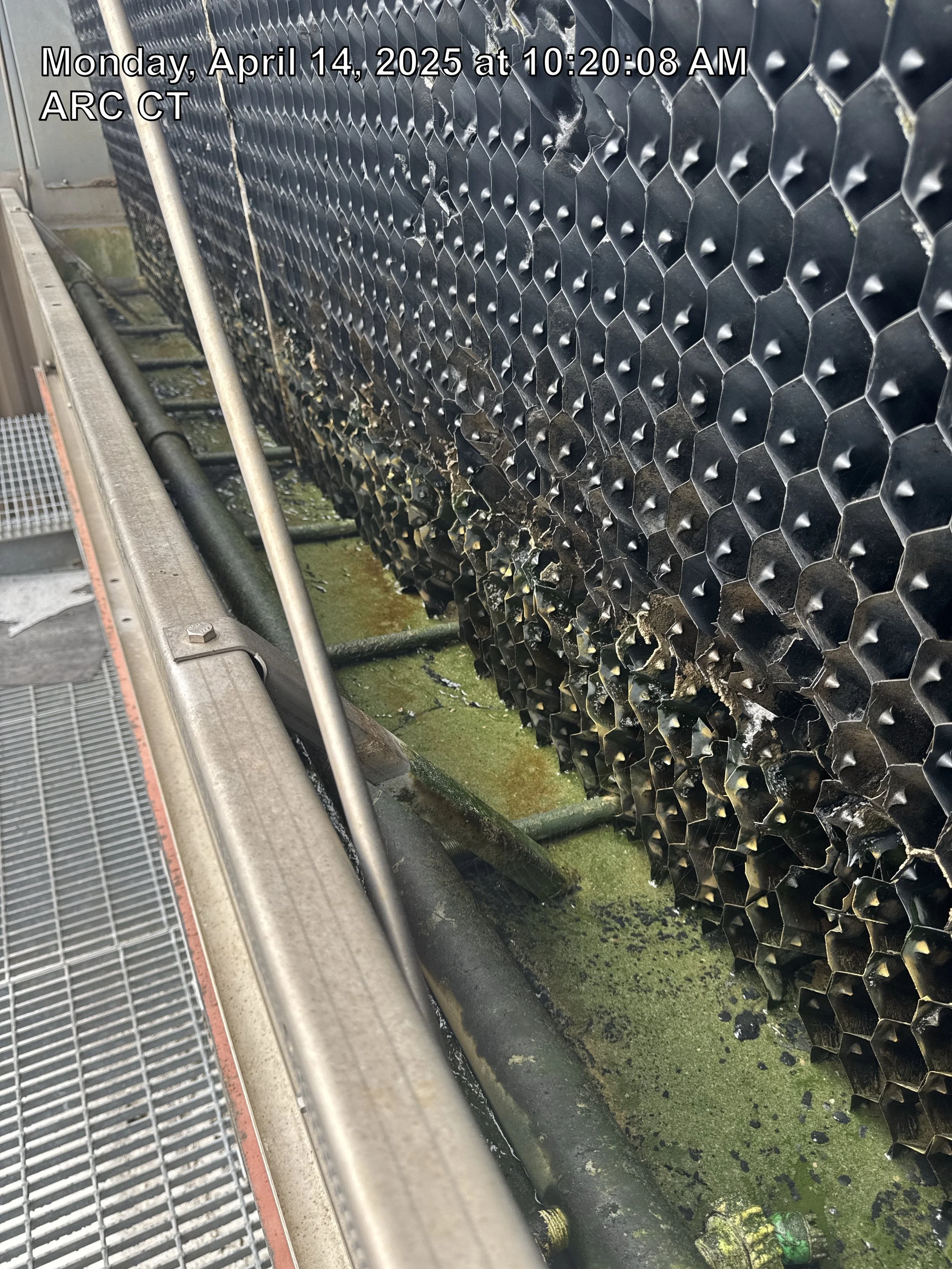
Mechanical cleaning of the basin, fill media, distribution deck, and drift eliminators to remove scale, sediment, and biofilm
Hyperhalogenation — introducing a high-concentration disinfectant to treat all wetted surfaces
Post-disinfection Legionella verification sampling before the tower returns to service
Local Law 159 also requires mandatory summertime hyperhalogenation disinfection between July 1 and August 31 followed by Legionella sampling and analysis within 3-14 days each year. Additional cleanings are required whenever Legionella results trigger corrective action, or when a tower has been offline for five or more days. See our Cooling Towers cleaning services.
What is the difference between full service, monthly service, and supervisory cooling tower treatment?
Full service: Acqua Treat technicians handle all chemical treatment, Legionella sampling, weekly bacteria monitoring, water quality records, documentation, and annual compliance filing. You don't manage the program.
Monthly service: Our technicians handle chemical treatment, Legionella sampling, and compliance documentation on schedule. Weekly water quality monitoring and between-visit records are handled by your in-house team.
Supervisory service: We supply chemicals, handle Legionella sampling, and provide technical oversight. Your staff performs day-to-day treatment and monitoring. Best suited to buildings with experienced maintenance personnel already actively involved in the cooling tower program. See our Cooling Towers service options.
What water-side problems cause NYC boiler inspection deficiencies?
The NYC Department of Buildings requires annual inspections of all boilers in commercial and residential buildings. Many of the most common deficiencies flagged during inspections are water-side conditions — problems caused directly by inadequate water treatment. These include:
Scale on heating surfaces — even a thin layer measurably reduces heat transfer efficiency, forces the burner to work harder, and can lead to tube failure
Corrosion and pitting on the boiler shell, tubes, or headers — caused by dissolved oxygen and low pH in untreated feedwater
Sludge accumulation in the boiler drum and mud legs — hardness salts precipitating out of untreated makeup water
Return line corrosion — condensate lines corroded from carbonic acid that forms when CO₂ dissolves in the condensate
Foaming and carryover — high dissolved-solids concentration causing water to enter the steam lines
If your inspection report flags any of these conditions, a corrective water treatment program is typically required as part of resolving the deficiency. Acqua Treat provides water-side assessments, corrective treatment programs, and written documentation to support your NYC DOB compliance filings. See our Boiler & HVAC Water Treatment page.
Building owners who have received boiler violation notices should contact us as soon as possible — unresolved violations accumulate monthly late fees and can block property sales, refinancing, and certificates of occupancy.
How often do steam boilers, hot water boilers, and closed loops need water treatment?
Steam boilers: Treatment chemicals should be fed on a regular basis throughout the heating season. Steam boilers process large volumes of makeup water and concentrate impurities over time — scale, oxygen attack, and condensate corrosion develop gradually and invisibly until a tube fails or an inspection flags a problem. A complete program includes regular chemical feed, regular water analysis (typically monthly or quarterly), and systematic blowdown management to remove concentrated boiler water.
Hot water boilers (hydronic heating): Similar to steam — regular chemical feed and regular water testing throughout the heating season. pH control, oxygen scavenging, and scale inhibition all need to be maintained. Many hot water systems also include a closed loop component.
Closed loops (hydronic heating loops, chilled water, condenser water): Because water recirculates continuously in a sealed system, any corrosion, scale, or microbiological contamination compounds over time without relief. Corrosion inhibitor levels should be tested and adjusted at least quarterly, with additional testing when system changes occur. Glycol systems also need inhibitor depletion testing — degraded glycol turns acidic and actively corrodes system metals.
NYC DOB requires annual boiler inspections, and water treatment records support a demonstration of proper maintenance. See our Boiler & HVAC Water Treatment page. If your system has been operating without a formal treatment program, contact us for a free assessment.
When is potable drinking water pipe disinfection required in New York City?
Under the NYC Plumbing Code (Section 610) and NYC DEP regulations, potable water pipe disinfection is required in the following situations:
New water mains and service piping before being placed into service
Repaired or replaced sections of existing water mains or building domestic water piping
New building plumbing systems installed as part of construction or renovation
Water systems returning from extended shutdown
Any system where contamination is suspected or confirmed
Disinfection must comply with AWWA C651 for water mains and service piping, or AWWA C652 for water storage facilities. The process involves flushing, introducing sodium hypochlorite to achieve 200 ppm chlorine concentration, maintaining a minimum three-hour contact time, and bacteriological sampling before the system enters service. See our Drinking Water Disinfections page.
What documentation do I receive after a potable drinking water pipe disinfection?
Every disinfection job Acqua Treat performs includes a full documentation package:
Written disinfection report: date, location, pipe sections treated, chlorine concentration achieved, contact time, and flush volumes
Certified laboratory results confirming absence of total coliform and E. coli
Chain of custody documentation for all samples
Certification letter confirming AWWA C651 compliance
This package is designed to satisfy NYC DEP, NYC DOB, and project engineer sign-off requirements. We can coordinate directly with your engineer of record or inspector if needed. Request a AWWA C651-compliant disinfection quote here.
When does my HVAC system need glycol and what type should I use?
Glycol is needed in any closed HVAC system where water could drop to or below freezing. In New York City, this typically includes:
Chilled water systems with outdoor or rooftop air-cooled chillers
Closed hydronic heating loops running through unheated spaces
Air handler coils in spaces that drop below freezing when the unit is off
Any system where water can remain stagnant in piping exposed to outdoor temperatures
For commercial building applications, we use inhibited propylene glycol. It is non-toxic, meets code requirements for systems near potable water or occupied spaces, and contains corrosion inhibitors that protect system metals. Typical concentration for NYC buildings is 30–40% by volume.
Glycol does not last indefinitely — inhibitors deplete over time and pH can drop, making the fluid corrosive. We recommend testing glycol concentration and inhibitor levels annually and replacing degraded fluid before it damages system components. See our full Glycol Services page.
What areas does Acqua Treat serve?
Acqua Treat serves commercial buildings throughout all five New York City boroughs — Manhattan, Brooklyn, Queens, the Bronx, and Staten Island — as well as Nassau County, Westchester County, and the wider New York metropolitan area. We have been serving the New York region since 1982.
We work with building owners, property managers, facility engineers, licensed master plumbers, general contractors, and municipal agencies including the NYC School Construction Authority, DDC, DASNY, and CUNY. Contact us at (516) 775-1030.
What credentials does Acqua Treat hold?
Our team holds the following credentials:
ASSE 12080 Legionella Water Safety and Management Specialist Certification
NYS Commercial Pesticide Applicator License (7G — cooling towers and drinking water disinfections)
Active membership in the Association of Water Technologies (AWT)
Over four decades of NYC-specific Legionella compliance, LL77 and LL159 documentation, and DOB violation remediation experience
Acqua Treat has been a family-owned commercial water treatment company serving New York City since 1982. Contact us!
What is the fastest way to get help with an urgent water treatment issue?
Call us directly at (516) 775-1030. We are available Monday through Friday, 8:30am to 4:30pm. For urgent situations — a positive Legionella test, a DOHMH inspection notice, an open DOB boiler violation, or an emergency disinfection need — calling is always faster than the contact form.
For after-hours emergencies, leave a voicemail and we will return your call promptly. For general inquiries and quotes, use the contact form and we will respond within one business day.
Don't see your question here? Call us at (516) 775-1030 or fill out our contact form — one of our specialists responds within one business day.